

Blog
The ERA of Digital Marketing with AI: The 2026 Guide
The Paradigm Shift in Modern Marketing
We are living through the most significant paradigm shift in marketing history. Digital Marketing with AI is not just changing how we market. It is redefining what marketing is. This is the new era.
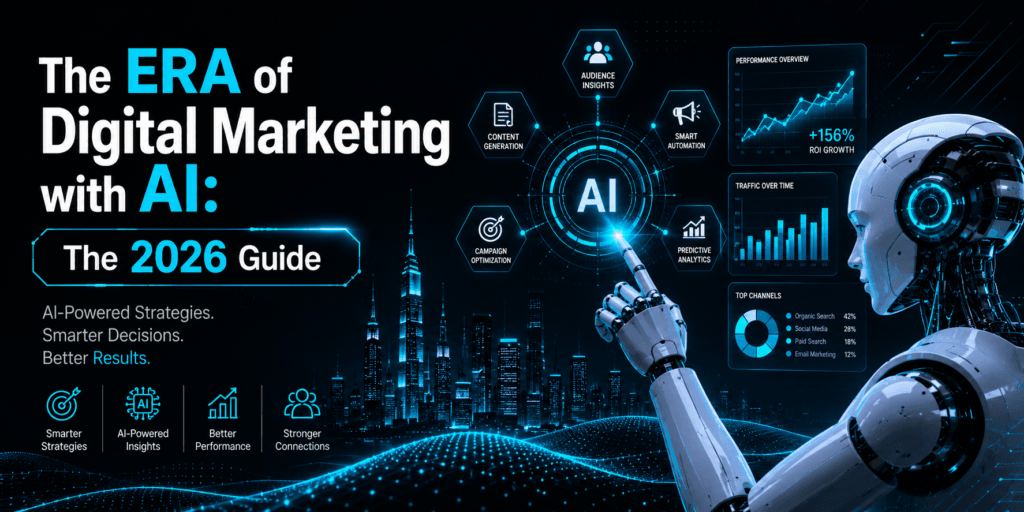
Unlike gradual technological shifts of the past, this transformation is moving rapidly. It demands immediate understanding and strategic commitment from every brand that wants to survive the decade.
For the past decade, digital marketing was built on human intuition. Analysts reviewed dashboards. Strategists wrote briefs—creatives produced content. Media buyers placed ads.
The process was methodical, cyclical, and relatively predictable. But artificial intelligence has collapsed that cycle. Workflows that once took weeks now execute in hours. Decisions that required senior expertise are now driven by models trained on billions of data points.
This is not incremental improvement. This is a structural change. Brands that understand the depth of this shift are building durable competitive advantages right now.
Phase 1 — The Signal Era: Digital Marketing with AI — Data Becomes Intelligence
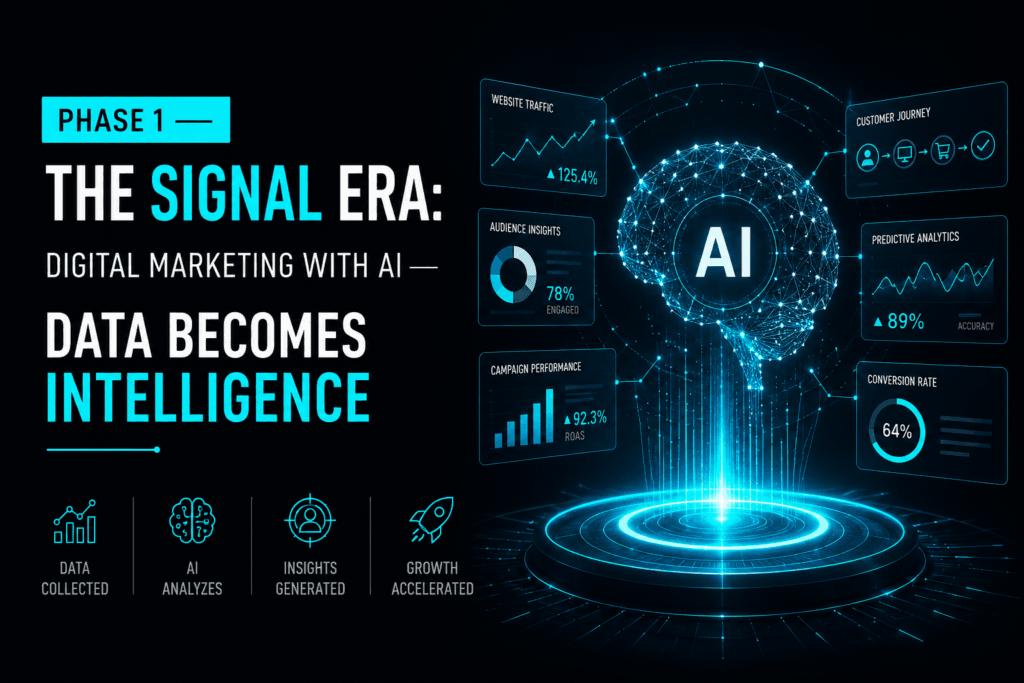
The first phase of Digital Marketing with AI was about listening. Machine learning models began processing the enormous volumes of behavioral data generated by the modern internet. They reviewed search queries, click patterns, purchase histories, and social interactions. They turned that raw signal into structured intelligence.
This gave birth to intent-based targeting. Brands can serve ads to people actively demonstrating purchase intent through their behavior rather than relying solely on demographic profiles.
Google’s marketing strategies and programmatic DSPs all operate on this foundation. The algorithm doesn’t just know who your customer is — it knows when they’re ready to buy. Google and third-party platforms use this foundation. The algorithm knows who your customer is and when they are ready to buy.
Intent Modeling in Digital Marketing with AI
- Intent Modeling: Artificial intelligence identifies purchase-ready signals from billions of micro-behaviors — transforming impressions from a reach metric into a precision instrument.
- Real-Time Bidding Intelligence: Smart Bidding algorithms now adjust bids in real time against your target CPA or ROAS, processing more signals per second than an entire media team could analyze in a month.
- Unified Audience Profiles: AI-powered CDPs now merge first-party CRM data with behavioral signals to create living audience profiles that update with every interaction.
Phase 2 — The Creation Era: Machines That Write, Design & Imagine
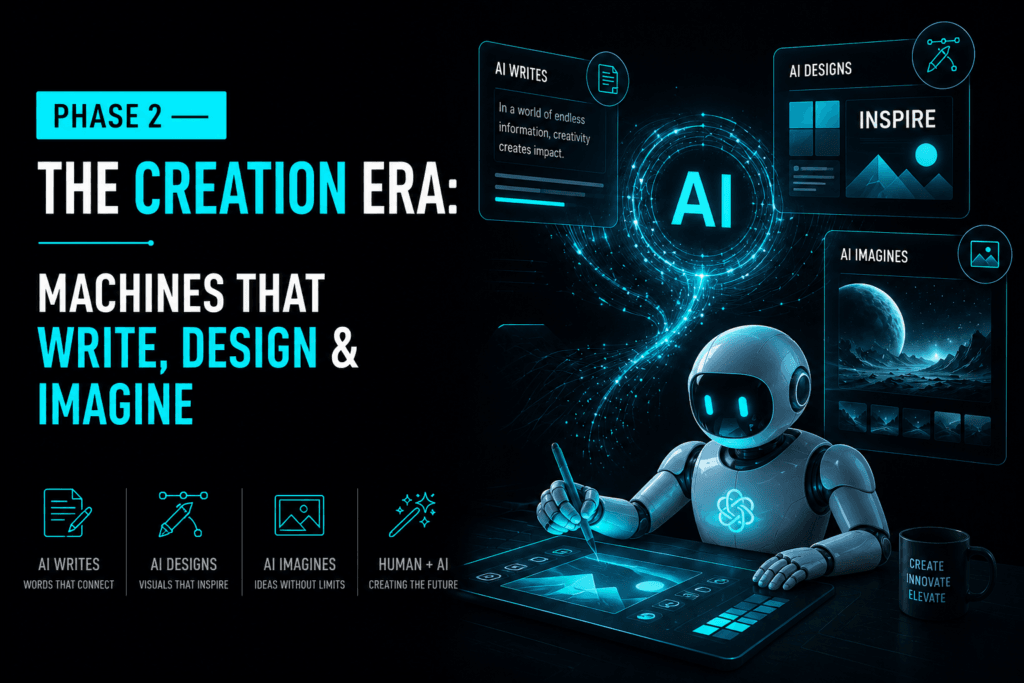
The second wave of disruption arrived with generative models. This wave struck at the heart of creative agencies. It altered the very domain they considered their own.
Tools like GPT-4, Claude, Midjourney, Sora, and ElevenLabs generate content rapidly. They create ad copy, brand imagery, video scripts, and voiceovers. They can even produce full campaign concepts. Production costs have plummeted as a result.
This development has been both liberating and disorienting for marketing teams. It is liberating because the bottleneck of production has collapsed. A single strategist can now produce dozens of creative variants in an afternoon.
It is also disorienting because the skills that once defined creative excellence are now table stakes. Models can easily replicate basic writing and design tasks.
For marketing teams, this has been both liberating and disorienting. Liberating because the bottleneck of production has collapsed — a single strategist can now produce dozens of creative variants in an afternoon. Disorienting because the skills that once defined creative excellence — writing a tight headline, art-directing a shoot — are now table stakes that models can replicate.
What Winning Creative Teams Look Like in 2026
The most effective marketing organizations have restructured their creative teams around a new division of labor. Senior creatives set strategic direction, define brand voice, and curate outputs. The technology generates, iterates, and scales. Human editors refine and approve. This model produces 5–10x the content volume of traditional teams — without sacrificing brand integrity.
How to Scale Generative AI Content Strategy Safely
Before scaling your content operations, it is essential to build a reliable and safe Generative AI content strategy that keeps your brand identity protected. This ensures that every piece of text, imagery, and variant aligns with your core corporate values. Ultimately, taking these precautions helps you avoid generic content while maximizing your organic reach and long-term sustainability.
- Establish AI-generated content guidelines that define which brand assets and tonal boundaries are non-negotiable before you scale production.
- Use multimodal tools to produce matched copy, visuals, and video in unified campaign systems — eliminating the handoff latency between creative departments.
- Feed the tools your highest-performing historical creative as reference. The best outputs begin with the best human examples.
- Implement human review gates for any AI-generated content before publication. Speed without governance creates brand risk.
Phase 3 — The Experience Era: Digital Marketing with AI Personalization
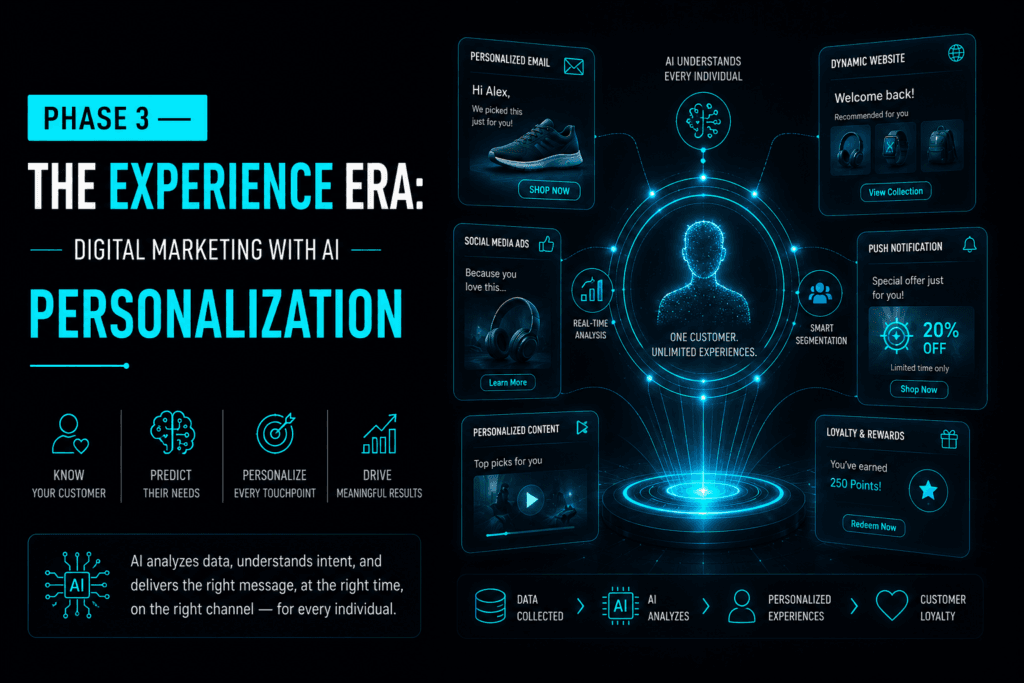
The third and most transformative phase of Digital Marketing with AI is the era of genuine personalization — not the rudimentary approach of email marketing past, but deep, dynamic adaptation of the entire customer experience based on real-time signals.
Platform systems can now serve a different version of your homepage to every visitor based on their source, prior behavior, geographic context, and predicted intent. Email sequences adapt their messaging, timing, and offers based on how each subscriber is engaging. Product recommendation engines serve items aligned not just with past purchases, but with predicted future need. The entire digital presence of a brand becomes a living, responsive system rather than a static set of pages and messages.
This capability comes with a corresponding responsibility. Personalization at this scale requires robust first-party data strategies, transparent consent frameworks, and rigorous data governance. In a world of increasing privacy regulation and growing consumer awareness, the brands that build trust alongside personalization will outperform those that optimize purely for conversion.
| The First-Party Data Imperative |
|---|
| With the deprecation of third-party cookies across major browsers and the enforcement of privacy frameworks like GDPR and CCPA, platforms are increasingly dependent on first-party data — information customers have voluntarily shared directly with your brand. Building rich first-party data assets through loyalty programs, gated content, and zero-party surveys is now a core strategic priority, not a technical afterthought. |
If you are wondering how these personalization trends impact search engine positioning, review our analysis on Search Engine Optimization to learn how to adapt technical factors to this landscape.
Key Performance Statistics
- 91% of top-performing marketers use AI tools weekly.
- 5x faster campaign iteration with AI-assisted creative.
- $620B AI-influenced digital ad spend projected by 2030.
Phase 4 — The Autonomous Era: Marketing That Runs Itself
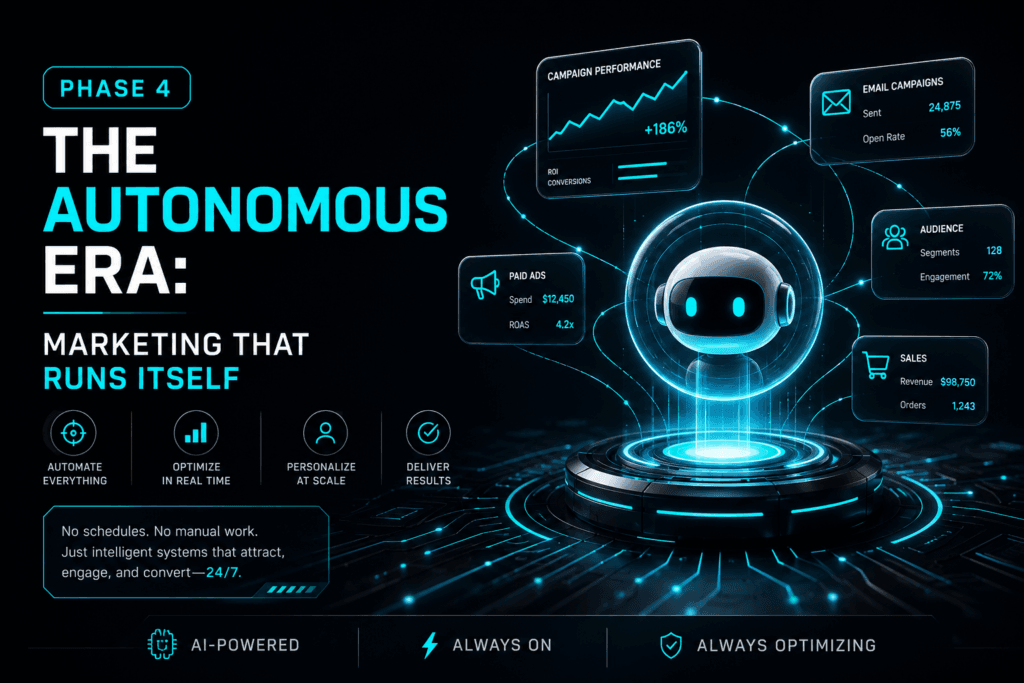
The fourth phase is autonomous marketing, and it is now fully underway. As a result, AI systems do not just assist human marketers. Instead, these systems plan, execute, optimize, and report on campaigns with minimal human intervention.
Furthermore, agentic AI systems can brief themselves on business objectives. They are powered by large language models connected to marketing APIs. Therefore, they can generate campaign strategies, launch and iterate ad creative, monitor performance in real time, and adjust strategy based on outcomes.
In 2026, leading brands are no longer piloting autonomous marketing. Consequently, they are scaling it. Early constraints around brand safety and creative judgment have been substantially addressed by advances in multi-modal reasoning and human-in-the-loop governance frameworks.
The question for most marketing leaders today is not whether to automate. Instead, it is which parts of the funnel to automate first and how to build the human oversight structures that keep brand integrity intact at speed.
Competing with Digital Marketing with AI in the Autonomous Era
- Begin auditing your current campaign workflows to identify which tasks are rule-based, repetitive, and data-driven. In particular, these are the highest-priority automation candidates.
- Invest in AI literacy across your marketing organization. The competitive gap between AI-fluent and AI-naive teams is widening dramatically. Thus, brands that haven’t acted are already behind.
- Develop a first-party data strategy that positions your brand to thrive in a privacy-first, AI-powered ecosystem.
- Redefine the role of your marketing team as AI orchestrators. Specifically, these are people who set objectives, curate outputs, and govern brand integrity while AI handles execution at scale.
| The New Era Has Already Begun |
|---|
| Every phase described here is unfolding simultaneously. The brands that act now — building data infrastructure, developing fluent teams, and embedding intelligent systems across the customer journey — are laying the foundation for a decade of compounding advantage. The question is not whether to embrace the Digital Marketing with AI era. The question is whether you’ll lead it or follow it. |