

Blog
The Meta Ads Playbook — Scale Your Brand Across Every Screen
When looking to scale your brand across every screen, using a complete Meta Ads Playbook is essential to establish your online presence. From Facebook Feed to Instagram Reels to WhatsApp — learn how to build Meta ad campaigns that reach 3.2 billion people and turn impressions into real revenue.
Meta’s advertising ecosystem is unlike any other platform in digital marketing. With 3.2 billion daily active users across Facebook, Instagram, WhatsApp, and Messenger, Meta Ads Playbook gives brands unparalleled reach — combined with the most sophisticated audience targeting engine ever built. But with great power comes great complexity. This guide cuts through the noise and shows you exactly how to build Meta campaigns that convert.
1. Understanding the Meta Ads Ecosystem
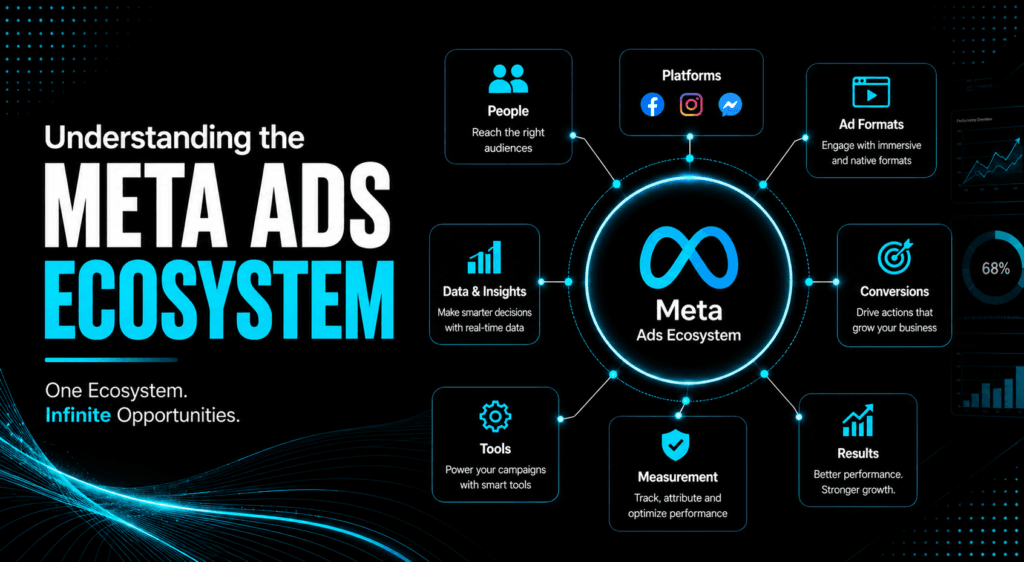
Before launching your first campaign, it’s essential to understand the full landscape of where your ads can appear and why Meta’s cross-platform reach is its greatest competitive advantage over any other paid channel.
Meta Ads Manager is the central hub from which you control campaigns across all four platforms simultaneously. Unlike Google Ads — which captures existing demand through search — Meta Ads Playbook create demand by interrupting users with compelling content while they scroll, watch, and connect. Furthermore, this fundamental difference shapes every strategic decision you’ll make when developing your Meta advertising strategy.
1. Using Meta Ads for Reach & Community
Still the largest platform in the Meta family with the broadest demographic reach. Specifically, Facebook excels at awareness campaigns, lead generation, and re-targeting older, high-purchasing-power demographics who remain highly active on the platform.
2. Instagram Visual Commerce with Meta Ads
The go-to platform for visually-driven brands, fashion, food, travel, and e-commerce. Consequently, Instagram’s Reels placement now drives the highest organic-feeling engagement at the lowest CPM — making it essential for any product-based advertiser focused on cross-device advertising.
3. WhatsApp & Messenger Conversational Commerce
Click-to-WhatsApp and Click-to-Messenger ads are among the fastest-growing formats in Meta’s portfolio. In addition, they drive direct conversations between brands and prospects, delivering exceptionally high conversion rates for high-consideration purchases.
2. Campaign Structure — The Foundation of Everything
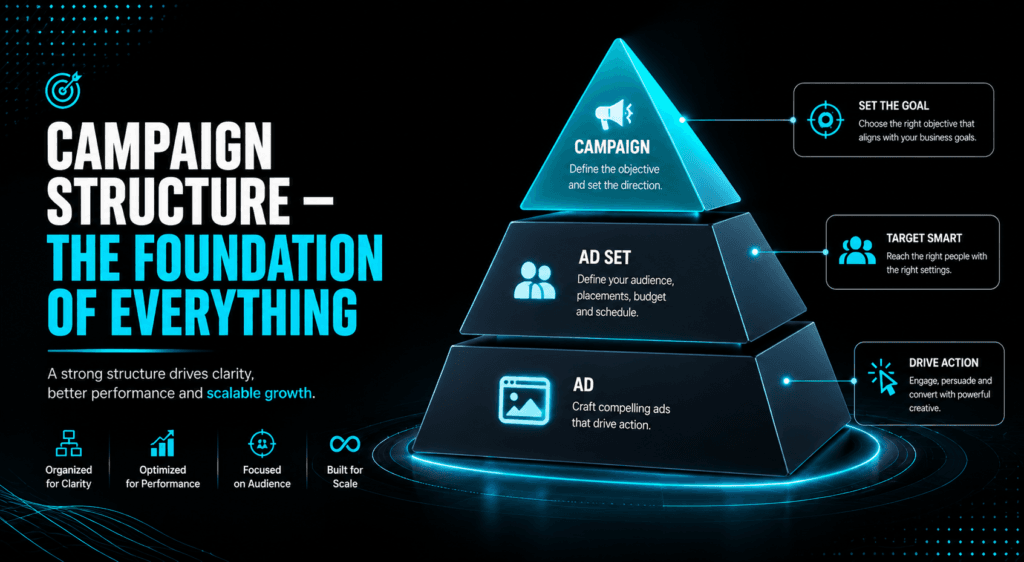
When structuring your ad account, the foundation you build will determine your ultimate success. First, you must align your campaign objective with your core business goal, rather than selecting options based on media preference. Consequently, if you want to drive direct purchases, you should select the “Sales” objective. Conversely, if you are looking to capture prospects, you must choose the “Leads” objective.
Furthermore, the algorithm relies on these primary settings to optimize ad delivery toward users who are most likely to take action. As a result, choosing the wrong objective early in the process will waste your budget on low-intent users. In addition, this foundational layer ensures that your budget is allocated correctly across ad sets without overlapping target audiences.
Therefore, it is critical to keep your account architecture clean and avoid unnecessary complexity. Ultimately, a streamlined structure allows the platform to gather conversion data faster and exit the learning phase efficiently. In short, getting your campaign structure right from day one is the most reliable way to scale performance.
| Strategic Rule Choose your campaign objective based on your business goal, not your media preference. If you want purchases, select “Sales.” If you want leads, select “Leads.” Meta’s algorithm optimizes delivery toward users most likely to complete your chosen objective — so misaligned here is expensive. |
| Campaign Objectives | Common Mistakes |
|---|---|
| Awareness — Reach & Brand recall | Using Traffic objective for sales campaigns |
| Traffic — Website or app visits | Too many ad sets splitting the budget |
| Engagement — Reactions & shares | Overlapping audiences causing auction conflict |
| Leads — Forms & messages | Ignoring the learning phase (50 events/week) |
| App Promotion — Installs | Changing ads before the learning phase ends |
| Sales — Purchases & ROAS | Not using Advantage+ placements |
3. Audience Targeting — The Core of Your Meta Ads Strategy
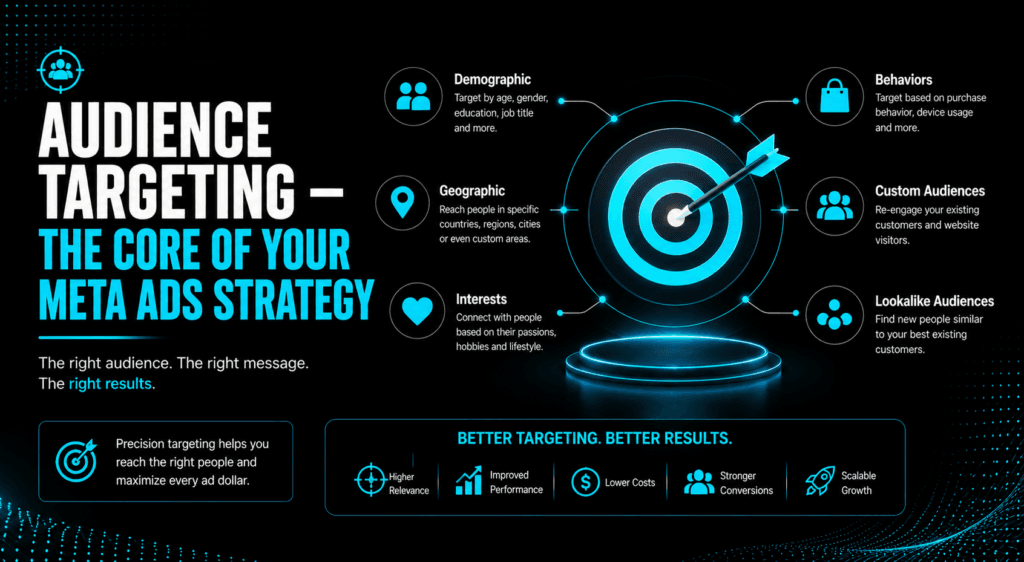
No other advertising platform has audience data as rich, behavioral, and actionable as Meta. First, the ability to layer demographic, interest, behavioral, and first-party data into precise audience segments is what makes Meta indispensable for performance marketers utilizing custom audience targeting.
- Core Audiences: Target by age, gender, location, language, interests, and behaviors. Therefore, these are best for top-of-funnel awareness when you lack first-party data.
- Custom Audiences: Upload your customer list, target website visitors via the Meta Pixel, or retarget video viewers and Instagram engagers. Thus, this is your highest-value targeting tool.
- Lookalike Audiences: Meta finds users who statistically resemble your best customers. A 1% Lookalike of your purchaser list is often the most efficient prospecting audience available.
- Advantage+ Audience: Meta’s AI-driven targeting that uses your input signals as guidance but expands reach when it detects conversion opportunities. Increasingly, it outperforms manual targeting.
- Re-targeting Sequences: Serve different ads to users based on where they are in the funnel: product viewers, cart abandons, and past buyers should each see uniquely tailored messaging.
4. Creative Strategy — The Real Differentiator
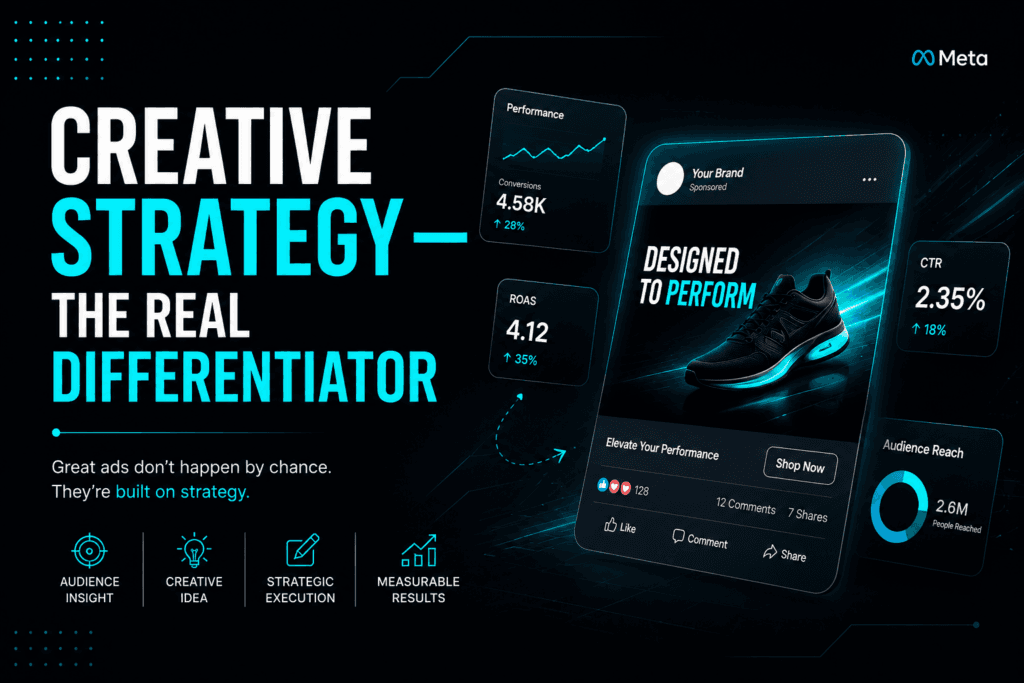
On Meta, creative is your targeting. In an increasingly AI-driven ad delivery system, the creative you produce determines who sees your ad more than any audience setting you configure. Meta’s algorithm distributes your ad to users who are most likely to respond to that specific piece of content — which means the quality, format, and message of your creative directly shapes your audience.
Designing Creatives for Your Meta Ads
When using the Meta Ads Playbook, your creative assets act as your primary targeting tool. Because Meta’s delivery system is highly automated and AI-driven, the images and videos you produce tell the algorithm exactly which users are most likely to convert.
Furthermore, to stand out in a dynamic social media feed, your creative strategy must focus on thumb-stopping formats that feel natural to the platform.
- The Power of Vertical Video: As attention spans shift, short-form, vertical video content (between 15–30 seconds) consistently outperforms static images across all major industries.
- Native Platform Aesthetics: Overly polished advertisements often perform worse than creator-led, authentic, or user-generated content (UGC). Therefore, you should design your creatives to blend seamlessly into the user’s organic feed or Reels tab.
- Continuous Creative Testing: Do not rely on a single asset. Instead, test varying hooks, calls to action, and visual styles to let the platform determine the winning variation.
| Creative Insight Video ads — particularly vertical Reels-format content between 15–30 seconds — consistently outperform static images across nearly every vertical in 2026. If you’re not producing native-feeling video content, you’re operating at a significant disadvantage. |
| Format | Best For | Avg. CTR | Effectiveness |
|---|---|---|---|
| Reels Video (15–30s) | Awareness, Brand storytelling | 1.8–3.2% | High |
| Single Image | Re-targeting, Direct response | 0.9–1.5% | Medium |
| Carousel | E-commerce, Multi-product | 1.2–2.0% | High |
| Collection Ad | Product discovery | 1.5–2.4% | High |
| Lead Form | B2B, Service businesses | 0.6–1.0% | Medium |
| Story Ad (Static) | Quick offers, Flash sales | 0.5–0.9% | Low-Medium |
5. Budgeting, Bidding & the Learning Phase
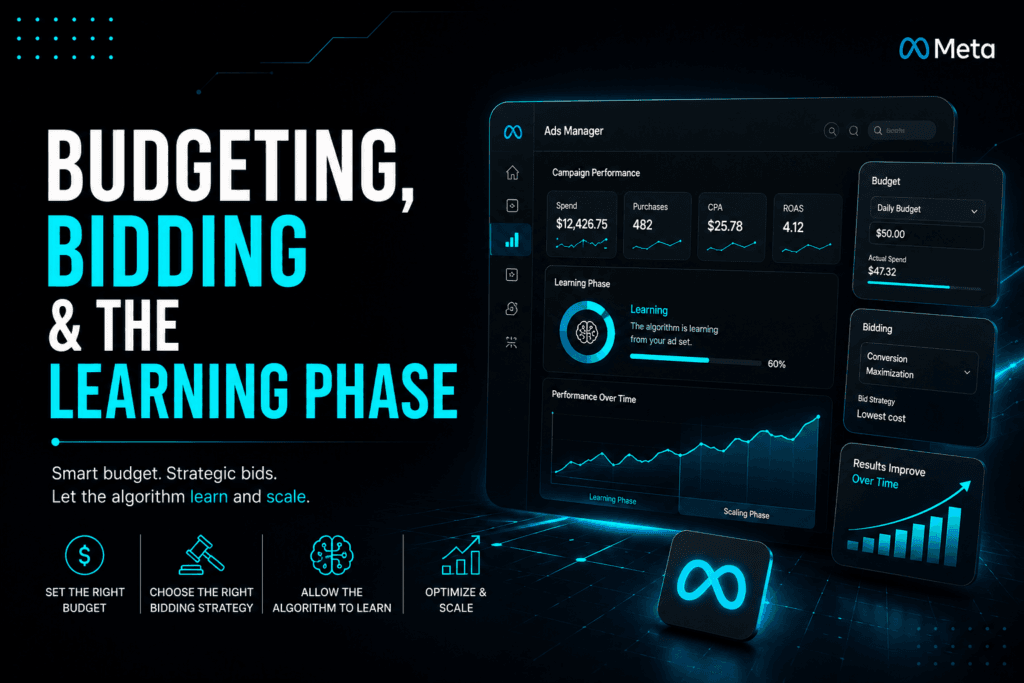
Meta’s auction system rewards advertisers who give the algorithm room to learn. The most destructive thing you can do is make frequent budget or audience changes before your campaign has gathered enough data — a period Meta calls the “learning phase.”
- Exiting the Learning Phase: Your campaign exits the learning phase after achieving approximately 50 optimization events per ad set per week — structure your budget to support this threshold.
- Campaign Budget Optimization: Use Campaign Budget Optimization (CBO) to let Meta dynamically allocate budget to best-performing ad sets rather than fixing spend per set manually.
- Bidding Options: Start with Highest Volume bidding for new campaigns, then layer in Cost Per Result caps once you have 2–3 weeks of stable performance data.
- Advantage+ Shopping Campaigns: Advantage+ Shopping Campaigns (ASC) are the new default for e-commerce advertisers — they combine prospecting and retargeting in one AI-managed campaign and typically outperform manual structures by 15–30%.
- Evaluation Timeframe: Budget for at least 2–4 weeks before evaluating performance — Meta’s algorithm requires time to optimize delivery and exit the learning phase.
| Budgeting Rule of Thumb Set your daily budget at a minimum of 5× your target cost-per-result. If your target CPA is $20, your daily budget should be at least $100 to give the algorithm enough events to optimize delivery effectively. |
6. Tracking, Measurement & iOS 14+ Considerations
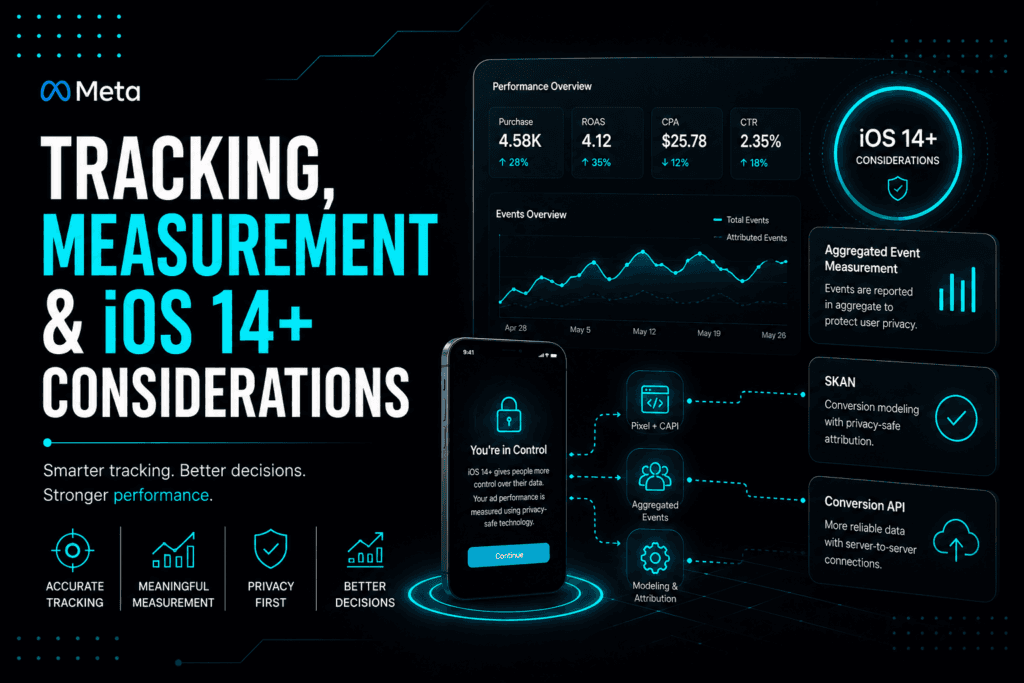
Apple’s App Tracking Transparency (ATT) framework, introduced with iOS 14.5, fundamentally changed how Meta tracks conversions. Understanding its impact — and how to mitigate it — is non-negotiable for any serious Meta advertiser in 2026.
- Install the Meta Pixel: Place it on every page of your website and verify it fires correctly using the Meta Pixel Helper Chrome extension.
- Implement Conversions API (CAPI): A server-side tracking solution that bypasses browser limitations and iOS restrictions, restoring lost conversion signals for your ROI-driven ad campaigns.
- Configure Aggregated Event Measurement (AEM): Prioritize your top 8 conversion events in Events Manager, ranked by funnel importance.
- Use UTM Parameters: Apply these parameters on all ad URLs and connect Meta Ads to Google Analytics 4 for cross-platform attribution modeling.
- Attribution Windows: Rely on the 7-day click, 1-day view attribution window as your primary performance metric — it offers the best balance between accuracy and actionability post-iOS 14.
7. Social Media Ad Scaling — Maximizing Your Reach
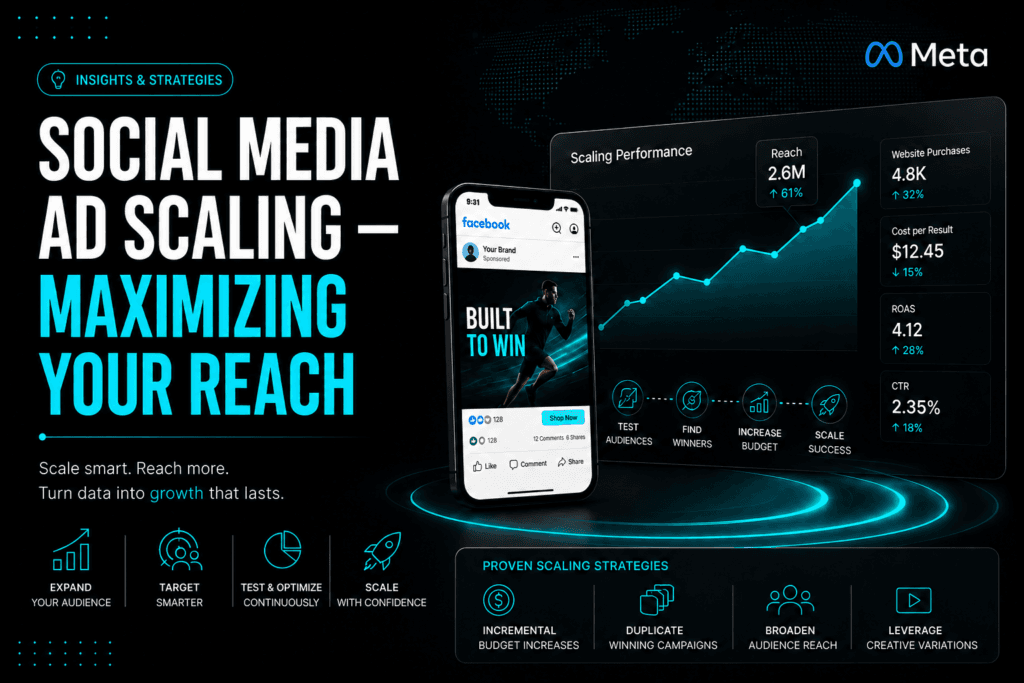
Once your creative content begins to gain traction, the next logical step in your strategy is social media ad scaling. Specifically, scaling campaigns efficiently relies on increasing your budget incrementally rather than making large jumps that could disrupt the learning phase.
When applied correctly, scaling enables you to push high-performing creative across multiple screens while keeping your cost-per-acquisition (CPA) stable. Ultimately, this disciplined approach allows you to capture a larger audience share across the entire Meta ecosystem.
| Scaling Insight: Avoid increasing your budget by more than 20% at a time. Consequently, you allow the algorithm to adjust to the higher spending threshold without resetting performance metrics. |
Meta Ads Tools & AI Tools for Scalable Social Advertising
- ♾️Meta Ads Manager – Create & manage Facebook/Instagram ads.
- 💼 Meta Business Suite – Manage pages, messages & campaigns.
- 📡 Meta Pixel – Track conversions & retarget users.
- 📊 Events Manager – Monitor & manage tracking events.
- 📱 Facebook Ads App – Manage ads on mobile.
- 🤖 ChatGPT – Write ad copy, hooks & audience ideas.
- ✨ Meta AI – Creative suggestions & automation.
- 🧠 Claude – Ad variations, scripts & creative strategy.
| The Advantage of Meta Ads — If You Earn It |
|---|
| As a matter of fact, Meta Ads Playbook in 2026 reward advertisers who work with the algorithm, not against it. To clarify, that means giving campaigns time to learn, investing in thumb-stopping creative, and building clean first-party data pipelines. Moreover, it requires resisting the urge to tinker constantly with your settings. Ultimately, the brands winning on Meta today share one trait: disciplined patience combined with creative ambition. Therefore, you should master the fundamentals in this guide and run structured tests. By doing so, you can build your way toward Advantage+ campaigns powered by rich conversion data. In conclusion, the scale available on Meta is genuinely unmatched. Consequently, the advertisers who unlock it consistently see it become their highest-returning channel. |