

Blog
Mastering Google Ads — Strategies That Actually Drive Results
The digital advertising landscape is more competitive than ever, so developing a winning Google Ads strategy is essential to move beyond basic setup and embrace optimization. Whether you are launching your very first Google Ads account or looking to refine existing campaigns, driving real results requires a strategic mix of technical precision and continuous improvement.
Google Ads Strategy remains the single most powerful paid acquisition channel in digital marketing. With over 8.5 billion searches per day, a well-structured Google Ads account can transform a struggling business into a market leader — or drain a budget with nothing to show for it.
The difference between campaigns that scale profitably and campaigns that bleed money usually comes down to Google Ads Strategy, rather than budget size. In this guide, we break down the core frameworks, targeting methods, and optimization tactics that top-performing advertisers use every day.
In 2026, Google processes over 9 billion searches every single day. For marketers who know how to use it, Google Ads remains the most direct path between a potential customer’s intent and your business. However, the landscape has shifted — AI-driven bidding, automated campaign types, and tightening privacy standards mean that strategy matters more than ever before.
The advertisers winning on Google Ads Strategy in 2026 are not necessarily spending the most — instead, they are the ones who have built the right campaign architecture, fed the algorithm quality data, and resisted the urge to constantly interfere with campaigns that need time to learn. As a result, this guide covers exactly how they do it.
Key Performance Statistics
- Daily searches processed by Google in 2026.
- $2+ Average revenue returned per $1 spent on Google Ads.
- 76% of businesses rely on Google Ads Strategy as a primary growth channel.
1. Choose the Right Google Ads Campaign Type
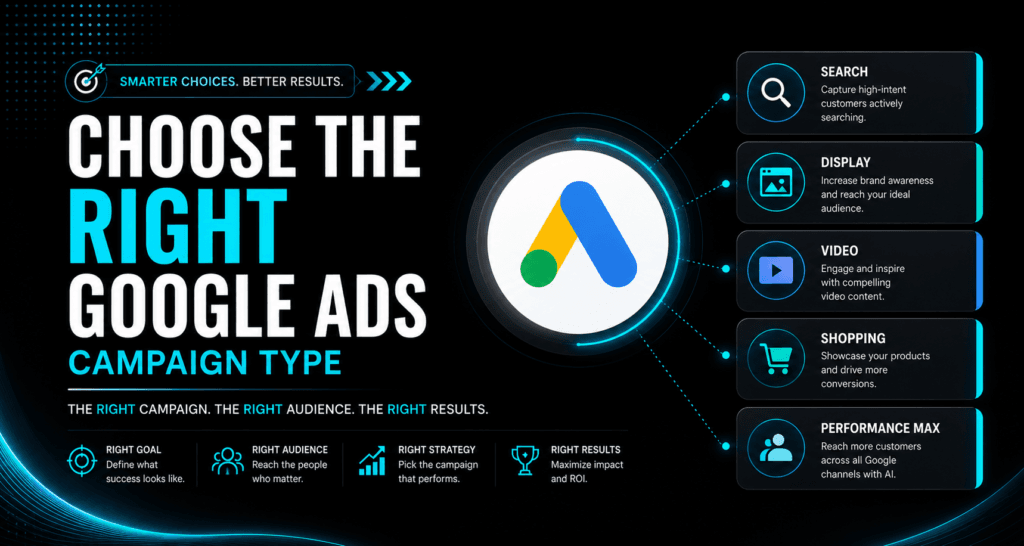
To run a successful PPC campaign, you must first select the campaign type that aligns with your business goals. Furthermore, whether your objective is lead generation, brand awareness, or direct online sales, choosing the right foundation is essential.
For a deeper understanding of campaign types and official performance recommendations, you can consult the official Google support documentation.
1. Search Campaigns — Capture High-Intent Demand in Google Ads
Text ads served to users actively searching for what you offer. These remain the highest-intent placements available and are ideal for lead generation, direct sales, and service businesses looking to convert demand that already exists in the market. Therefore, this format is best for capturing high-intent users actively searching for your services.
2. Performance Max — Let AI Drive Across All Google Ads Channels
P-Max runs across Search, Display, YouTube, Gmail, and Maps simultaneously. In 2026, Performance Max campaigns with rich asset groups and strong conversion data consistently outperform single-channel campaigns — thus making them the default choice for advertisers with mature accounts and clear conversion goals. As a result, it is best for utilizing cross-channel inventory using machine learning models.
3. Shopping Campaigns — Perfect for E-Commerce Google Ads
Product listings with images, prices, and store names appear at the very top of Google results. Shopping campaigns drive significantly higher click-through rates for product-based businesses and integrate seamlessly with Google Merchant Center for automated, real-time feed management.
4. Display & YouTube — Build Awareness at Scale with Google Ads
Visual placements across Google’s 2M+ partner sites and YouTube reach users before they’re actively searching. Consequently, these formats are ideal for top-of-funnel brand awareness and remarketing.
Best Practices for Campaign Structure
- Keep ad groups highly focused: Group your keywords by theme so you can serve hyper-relevant ad copy.
- Refine match types: Use phrase and exact match types to prevent wasted ad spend on irrelevant search terms.
- Test ad extensions: Add site links and callouts to increase your real estate on the search engine results page.
2. Keyword Strategy: The Foundation of Search in Google Ads
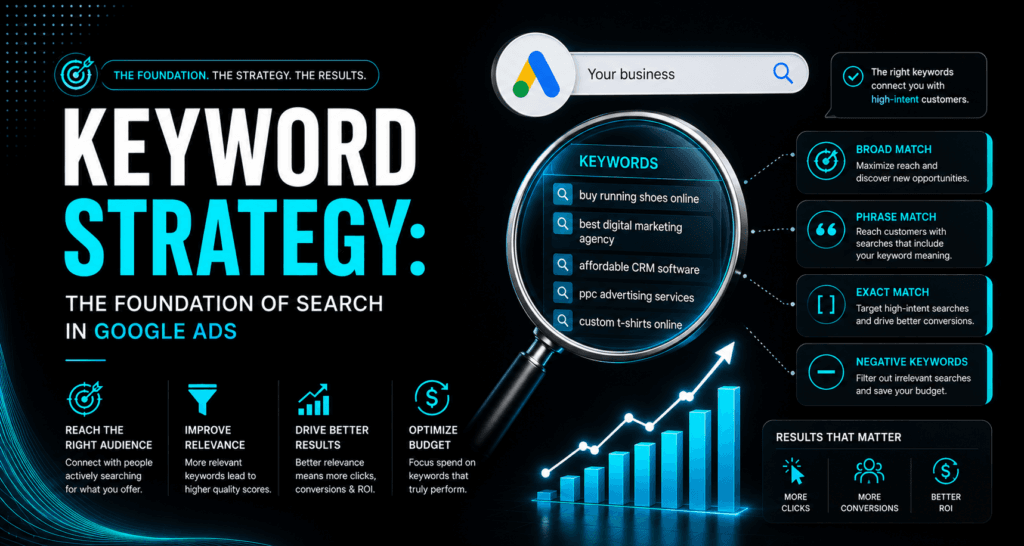
Keyword selection is where fortunes are made or lost in Google Ads. Ultimately, the goal is to appear for queries with strong commercial intent while filtering out irrelevant traffic that consumes budget without converting.
Connecting with the right audience requires deep keyword research. Therefore, using the right Keyword Research Tool helps you find low-cost, high-converting terms that your competitors may have missed.
Keywords are the engine of every Search campaign. In 2026, effective keyword strategy is less about volume and more about precision — identifying exactly what your ideal customers search when they are ready to act, and structuring your account to capture those moments efficiently while excluding the queries that drain budget without delivering results.
Match Types — Use Them Deliberately in Your PPC Campaign
- Use Google Keyword Planner and Search Terms reports to identify high-intent, lower-competition queries.
- Organise keywords into tightly themed Ad Groups — no more than 15 keywords per group.
- Build your negative keyword list before launch — include “free,” “DIY,” “course,” and “how to” at minimum.
- Review the Search Terms report weekly to add converting queries and exclude wasteful ones.
- Dedicate higher bids and tailored landing pages to your highest-intent transactional keywords.
Best Practices for Keyword Strategy Using Your Keyword Research Tool
- Refine match types: Use exact and phrase match types to prevent wasted budget on irrelevant queries.
- Leverage negative keywords: Exclude irrelevant search terms to keep your ad spend focused.
- Group ad groups tightly: Keep your keyword themes small so you can serve relevant ads.
| 💡 Pro Tip Broad Match is now more powerful than ever when paired with Smart Bidding — but it demands discipline. Start with Exact and Phrase Match for control, then layer Broad Match only into campaigns with 50+ monthly conversions. Never run Broad Match without Target CPA or Target ROAS bidding protecting your budget. |
3. Google Ads Smart Bidding & Budget Allocation
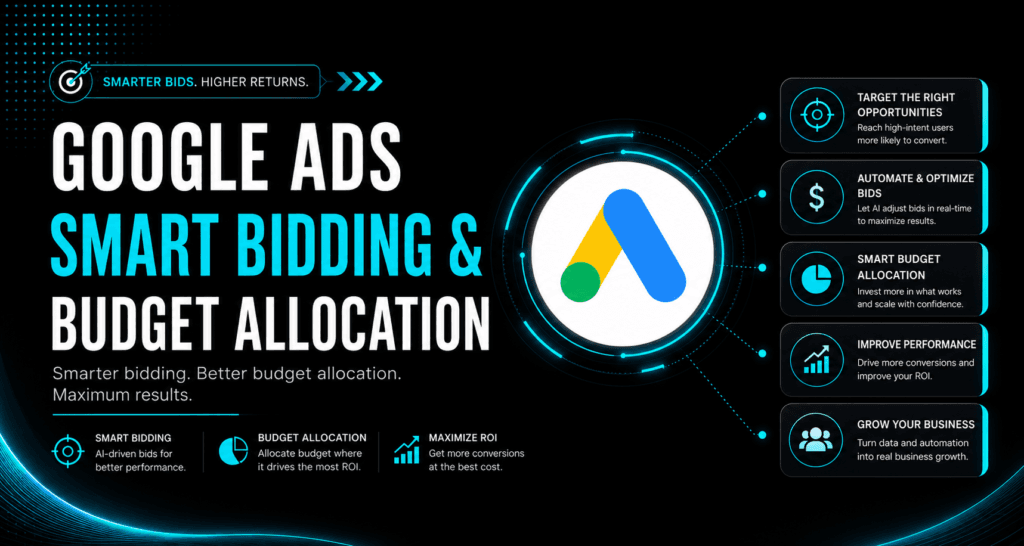
Manual bidding is effectively obsolete in 2026. Google’s Smart Bidding strategies evaluate hundreds of real-time signals — device, location, time of day, search context, audience membership, and browsing history — to set the optimal bid for every single auction automatically. Thus, your role is to provide the right objective and the data quality the algorithm needs to perform.
Understanding how your budget works is essential to controlling costs. Consequently, monitoring your Cost-Per-Click (CPC) ensures you do not overpay for low-converting traffic.
Moreover, smart bidding utilizes machine learning algorithms to maximize results based on your target goals. By setting target CPAs, you allow the platform to adjust bids in real-time. As a result, this helps you get the most out of your budget while keeping acquisition costs predictable.
If you want to maximize your returns without managing the day-to-day complexity, you can have professionals help you set up and optimize your PPC campaigns to keep your acquisition costs low.
1. Target CPA (Cost Per Acquisition) for Better ROAS
Tell Google your desired cost per conversion and let the algorithm optimize bids to hit that target. In particular, this is best when you have 30+ conversions per month for reliable data signals.
2. Target ROAS (Return on Ad Spend) in Google Ads
Ideal for e-commerce. Google optimizes bids to maximize conversion value at your specified return. However, it requires strong conversion tracking with value data attached to each transaction.
3. Maximize Conversions (with a CPA Cap) for Better Cost-Per-Click (CPC)
Great for new campaigns or accounts with limited data. Let Google find conversions while you establish history, then layer in Target CPA constraints as data matures.
| Best Bidding Strategies | Bidding Mistakes to Avoid |
|---|---|
| Target CPA — lead generation focus | Editing bids before learning phase ends |
| Target ROAS — E-commerce revenue | Setting unrealistic CPA targets too early |
| Maximize Conversions — new campaigns | Using Broad Match without Smart Bidding |
| Maximize Conversion Value — revenue growth | Splitting budget across too many ad sets |
4. Audience Targeting & Remarketing with Google Ads
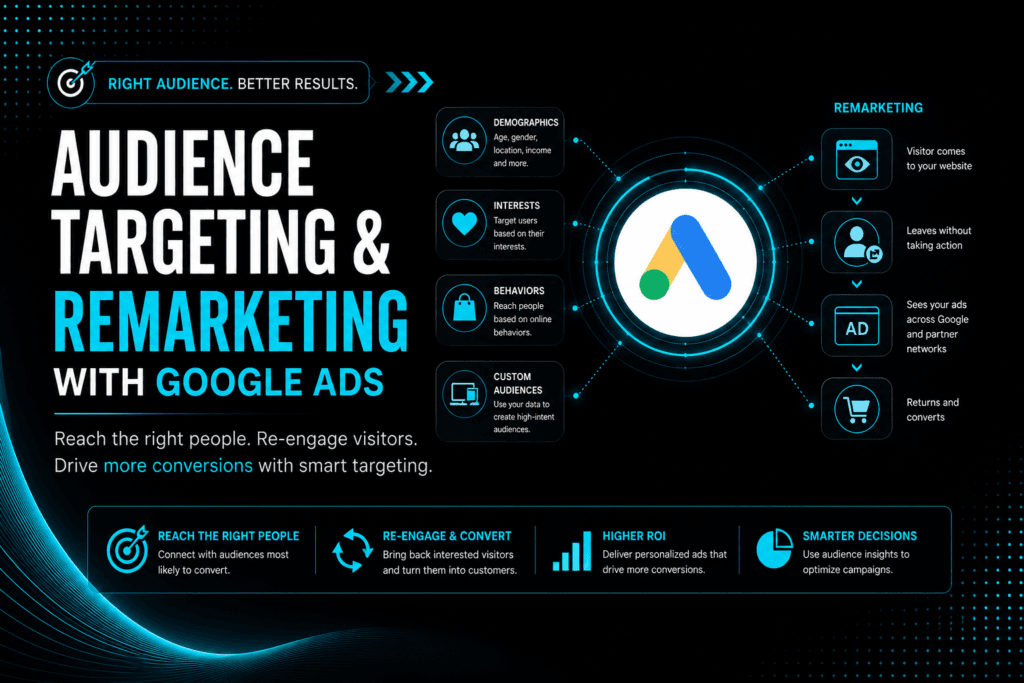
With the changing privacy landscape and the deprecation of third-party cookies, targeting has become highly dependent on your first-party data. Specifically, by using Customer Match lists, you can re-engage previous visitors with custom ads across the Google network.
Reaching the right person at the right time is the core promise of digital advertising. Therefore, audience capabilities let you layer intent, demographics, and behavioral data on top of keyword targeting for precision at scale.
Advanced Audience Strategies for Better Conversion
- Layer In-Market Audiences on Search campaigns as bid adjustments to boost bids for high-intent users.
- Create Customer Match audiences by uploading your CRM data for targeting and exclusion.
- Build remarketing lists for Search Ads (RLSA) to bid more aggressively for past website visitors.
- Use Similar Segments (formerly Similar Audiences) to reach users who behave like your best customers.
- Set up a YouTube re-marketing funnel to re-engage video viewers with search ads.
Best Practices for Re-Engagement
- Segment your audience: Create distinct ad groups for cart abandoners versus past purchasers.
- Personalize the ad copy: Speak directly to the previous engagement level of the user.
- Monitor frequency caps: Prevent ad fatigue by limiting how often a user sees your retargeting assets.
5. Ad Copy & Quality Score Optimization
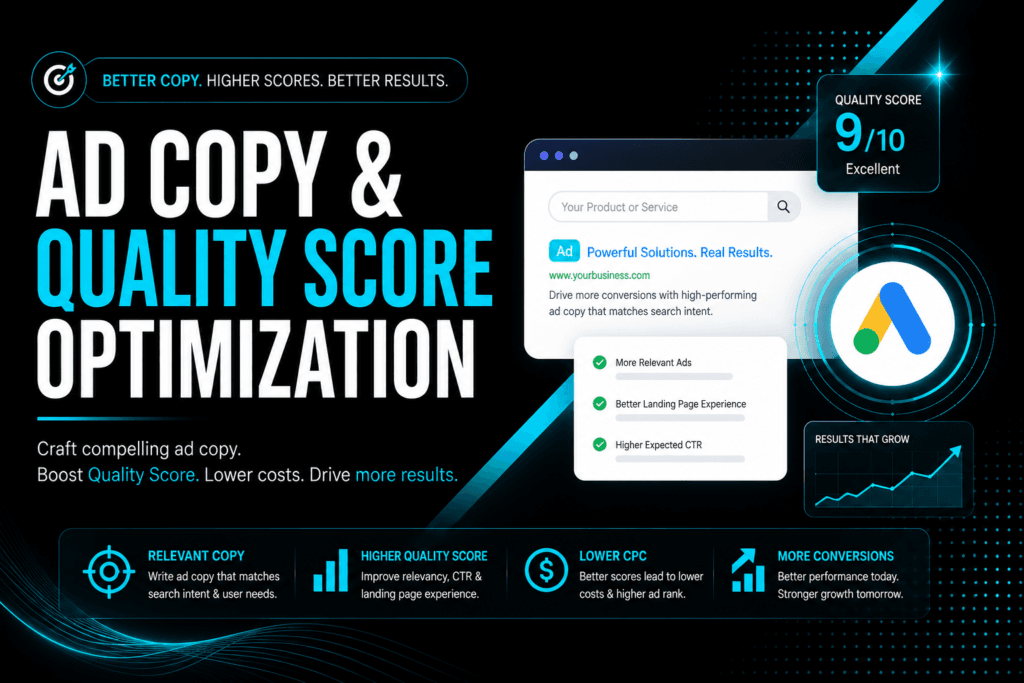
Your Quality Score acts as a diagnostic tool that estimates the quality of your ads, keywords, and landing pages. In addition, a high score lowers your actual Cost-Per-Click and improves ad positioning.
Quality Score — Google’s rating of your ad relevance, expected click-through rate, and landing page experience — directly determines both your ad position and the cost per click you pay. A higher Quality Score means you can outrank competitors while spending less. Although Responsive Search Ads remain the standard text format, creative diversity and asset quality have never carried more weight.
A. Write Responsive Search Ads with Full Asset Coverage
Provide all 15 headlines and 4 descriptions. Pin critical messaging to positions 1–2, and let Google’s AI test the remaining combinations. Furthermore, monitor the “Ad strength” score and aim for “Excellent.”
B. Mirror Keywords in Your Ad Copy
Include your target keyword naturally in at least one headline. As a result, this signals relevance to Google and to the user, since broad keyword matching in ads increases CTR meaningfully.
C. Use All Available Ad Extensions (Assets)
Sitelinks, callouts, structured snippets, call extensions, and image assets expand your ad real estate significantly. Indeed, accounts using full extensions see 15% higher CTR on average.
Three Pillars of Quality Score
- Expected click-through rate (CTR): The likelihood that your ad will be clicked when shown.
- Ad relevance: How closely your ad copy matches the user’s search intent.
- Landing page experience: The relevance and transparency of the destination page.
6. Conversion Tracking & Measurement with Google Ads
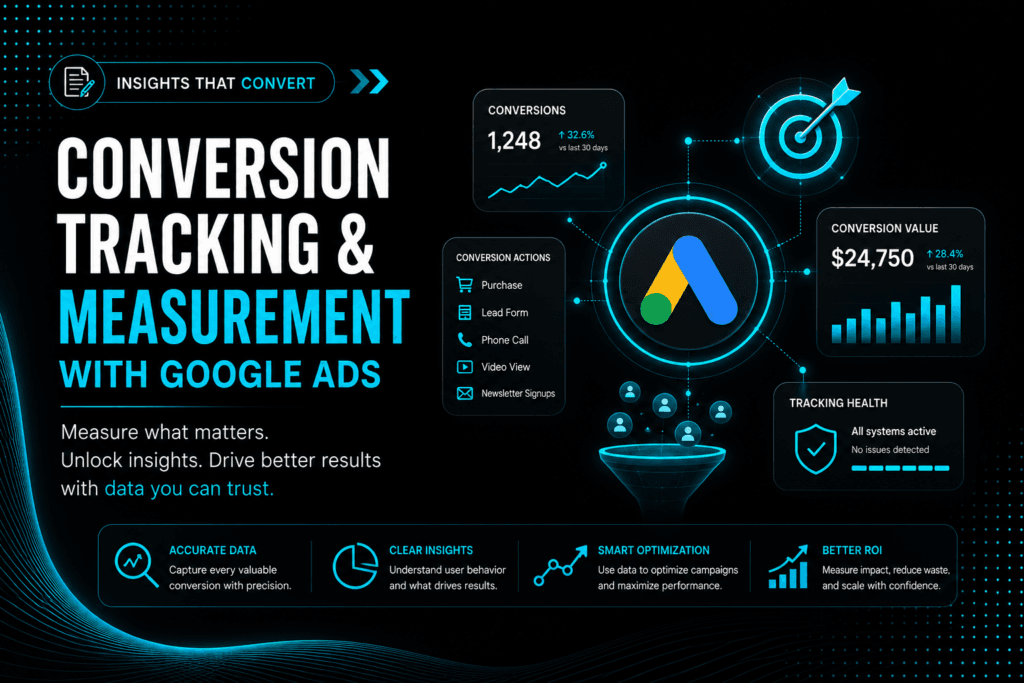
You cannot optimize what you do not measure. Conversion tracking is the single most important technical setup in any Google Ads account. Otherwise, Smart Bidding is flying blind. In addition, performance reporting becomes entirely meaningless.
Every step of the user journey must be tracked. Once a user clicks your ad, the destination page sets the final expectation. Furthermore, it must load quickly. Ultimately, a relevant and transparent landing page ensures users complete the intended action.
Enhancing Measurement Strategy
- Implement Google Tag Manager — Ensure all conversion tags fire correctly across your site.
- Track all meaningful conversion actions — purchases, leads, phone calls, form completions.
- Monitor primary and secondary events — For example, distinguish between micro-conversions (newsletter signups) and macro-conversions (sales).
- Assign realistic conversion values — even for non-revenue actions (e.g., a lead = $50 estimated value).
- Enable enhanced conversions to improve accuracy with first-party data.
- Connect Google Ads to Google Analytics 4 for cross-channel attribution.
Tracking User Actions
- Ensure content relevance: The page must contain the information and keywords promised in the ad text.
- Optimize page speed: Mobile-friendly, fast-loading pages reduce immediate bounce rates.
- Establish Trust: Include accessible privacy policies, contact information, and clear trust signals.
7. AI-Powered Video Creation for Smarter Advertising
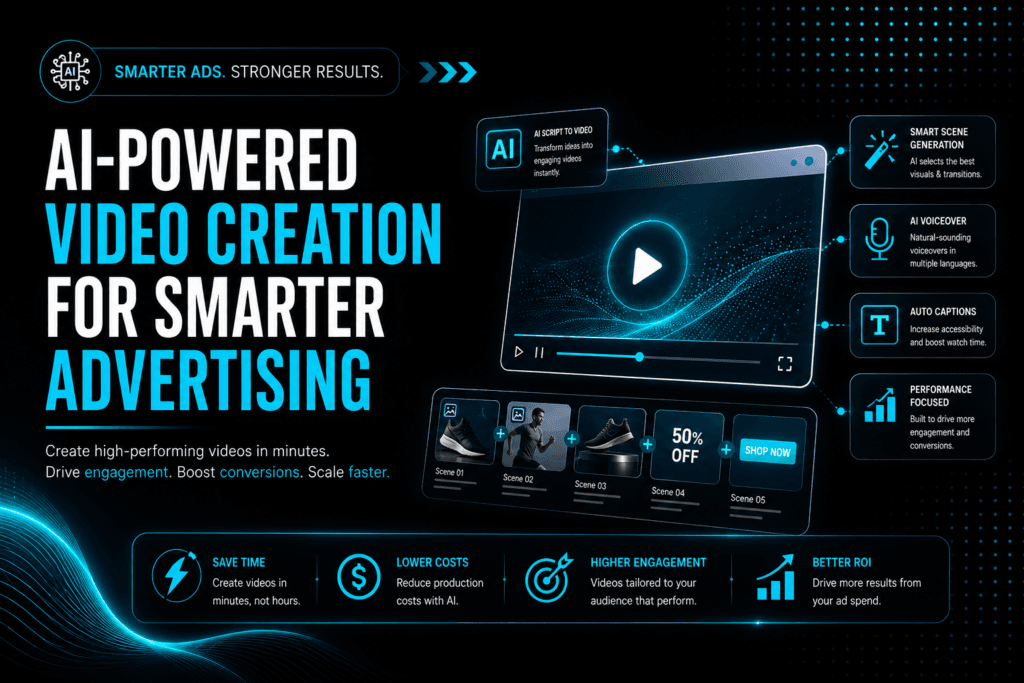
The introduction of Veo in 2026 marks a major shift. In fact, it brings AI-driven creativity to digital marketing. Veo is Google’s advanced generative video model. Specifically, it lets advertisers instantly turn static images into engaging video ads. Moreover, this happens directly inside the platform. As a result, you do not need professional editing tools or production teams.
Ultimately, the goal of digital advertising is revenue generation. Tracking your Return on Ad Spend (ROAS) allows you to determine exactly how much revenue is generated for every dollar spent on advertising.
How to Optimize for ROAS
- Implement enhanced conversions: Track actions across multiple devices accurately.
- Optimize post-click landing pages: Improve the conversion rate to generate a higher return on investment, solidifying your Google Ads performance.
Integrating Generative Video Assets
- Incorporate multi-modal ads: Build short, AI-assisted video creatives that hook viewers in under 5 seconds.
- Test AI-driven variations: Meanwhile, let the platform test multiple calls-to-action within your video assets.
What Makes Veo a Game-Changer?
Furthermore, this innovation removes one of the biggest barriers in advertising. For example, it eliminates video production complexity and cost. Ultimately, it makes high-quality video ads accessible to everyone.
- Convert up to three images into short, ready-to-use video ads (around 10 seconds)
- Create multiple video variations quickly to improve ad performance
- Scale creative production without high costs or technical skills
- Personalize video ads based on audience interests and trends
In simple terms, Veo transforms Google Ads Strategy from just an advertising platform into a complete AI-powered creative studio, helping marketers produce, test, and scale video ads like never before.
Why It Matters for Advertisers
Veo empowers businesses to:
- Improve Ad Strength with more diverse creative assets.
- Respond faster to trends with AI-generated content.
- Run better-performing campaigns, especially on YouTube and Demand Gen campaigns.
In simple terms, Veo transforms Google Ads from just an advertising platform into a complete AI-powered creative studio, helping marketers produce, test, and scale video ads like never before.
Google Ads Tools & AI Tools for High-Performance Campaigns
- 🔺Google Ads – Create, manage & optimize ad campaigns
- 🔑 Google Keyword Planner – Find keywords & search volume
- 📈 Google Analytics – Track website traffic & conversions
- 🏷️ Google Tag Manager – Manage tracking codes & tags
- 📊 Looker Studio – Create client reports & dashboards
- ✏️ Google Ads Editor – Bulk edit campaigns efficiently
- 🤖 ChatGPT – Generate ad copy, keywords & strategies
- ✨ Google Gemini – AI insights, campaign ideas & analysis
- 🧠 Claude – Long-form ad copy, landing pages & deep analysis
The Compounding Advantage of Disciplined Optimization
The advertisers who win long-term on Google Ads Strategy do not need the biggest budgets. Instead, they build disciplined optimization processes. First, perform weekly search term audits. Next, complete monthly bid strategy reviews and quarterly landing page tests.
Ultimately, ongoing creative refreshes create a compounding advantage that budget alone cannot replicate. Therefore, start with solid fundamentals: the right campaign type, clean keyword architecture, proper conversion tracking, and relevant ad copy. From that foundation, layer in audience targeting, Smart Bidding, and creative testing.
The results won’t happen overnight — but with consistent attention, Google Ads Strategy remains one of the highest-ROI channels available to any business, at any scale.
Therefore, start with solid fundamentals. Ensure you have the right campaign type and clean keyword architecture. In addition, maintain proper conversion tracking and relevant ad copy.